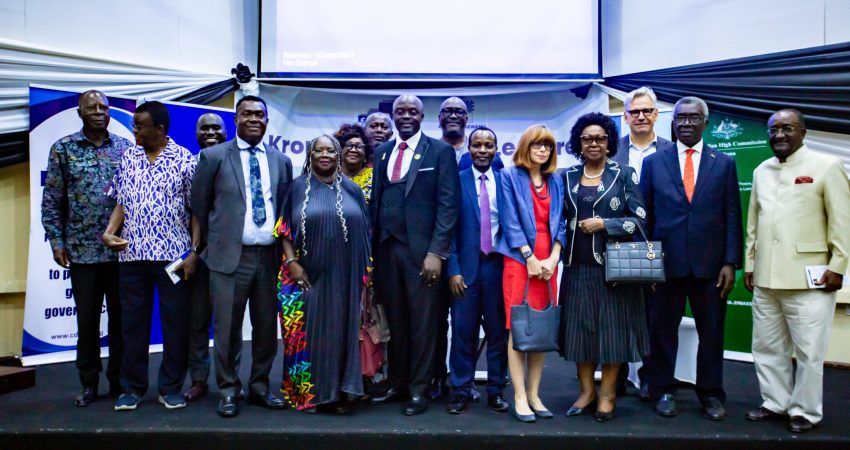
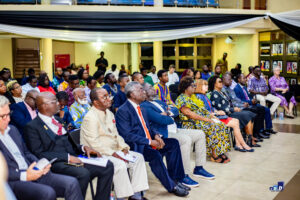
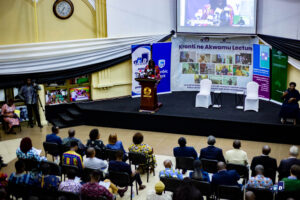
The Ghana Center for Democratic Development (CDD-Ghana) has marked the 20th edition of its flagship democracy and good governance lecture series, ‘Kronti ne Akwamu,’ with a national reflection on Ghana’s long struggle against illegal mining. The event, held on Thursday, November 27, 2025, at the Ghana Academy of Arts and Sciences in Accra, brought together policymakers, diplomats, civil society groups, journalists, and students for a candid conversation about the governance failures driving the galamsey crisis.
Delivering the keynote address on the theme “Galamsey: A Country’s Search for a Solution in Plain Sight,” investigative journalist Erastus Asare Donkor laid out a detailed account of why illegal mining continues to thrive despite years of task forces, military operations, and promises of reform. His lecture drew from field investigations, official data, and experiences from affected communities.
“Ghana’s rivers tell the story of our failure in the fight against galamsey,” he said, adding that river bodies, forests, farms, and entire communities are carrying the weight of a problem that has been allowed to fester. He noted that Ghana recorded the highest proportion of forest loss among tropical countries in 2022, losing 18,000 hectares of primary forest. “These are not just numbers; they reflect a country in distress,” he said.
Mr. Donkor argued that the crisis persists not because of weak laws, but because responsible institutions and local actor
s have failed to enforce them. “These crimes against nature persist not because laws are lacking, but because DCEs, chiefs, MPs, law enforcement agencies, and other opinion leaders have not attached the seriousness required to stop them.”
He also highlighted troubling weaknesses within the justice system. “Out of 1,190 illegal miners arrested between 2023 and October 2025, only 35 have been successfully prosecuted,” he said. A key point of his lecture focused on the opaque and cumbersome licensing regime. He describe
d the current process as a “complex maze” that pushes many into illegality and called for the Minerals Commission to roll out the long-delayed excavator tracking system. “Every excavator must be registered and tracked. This is not rocket science,” he stressed.
Chairing the event, renowned cardiothoracic surgeon Prof. Kwabena Frimpong-Boateng issued a firm warning about the political economy surrounding illegal mining. “A lot of people who have presidential ambition are building their war chest with money from illegal mining,” he said, describing the practice as a threat to the country’s future.
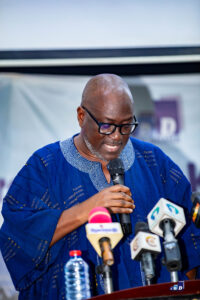
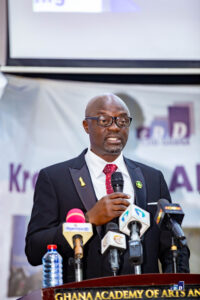
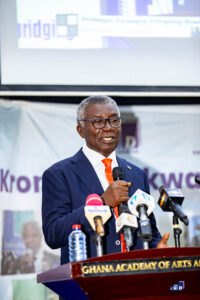
In his welcome address, Prof. H. Kwasi Prempeh, Executive Director of CDD-Ghana, said the conversation was long overdue. “We seem to know the cost of the problem – our water bodies, our environment, our public health. All that information is readily available. What continues to elude us is the solution to the problem,” he said, noting that galamsey has captured national attention more than almost any other governance issue in the Fourth Republic. Yet, the country still struggles to find a sustainable path forward.
In a solidarity message, the Australian High Commissioner to Ghana, H. E. Berenice Owen-Jones, emphasized the need for collective, long-term solutions. “There can be no doubt about the complexity of the challenge and the need for multi-faceted solutions. As the government develops and implements the strategy for the extractive sector, Australia stands ready to support these efforts where possible,” she said.
Mr. Mawuko Afadzinu, Head of Brands and Marketing at Stanbic Bank, reiterated the bank’s commitment to supporting responsible development. “Our business depends on this country thriving and operating at the highest standards. It also depends on Ghana being a beacon of hope for the youth, and whatever it takes to make our country prosperous is what the bank stands for. I do not doubt that this conversation on illegal mining will deepen public understanding of the crisis and hopefully, galvanize collective action toward policy solutions,” he emphasised.
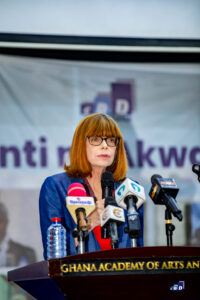

In addition to Stanbic Bank and the Australian High Commission, the Center received support from Satguru Travels, KPMG, Multimedia Group Limited, Sunlodge Hotel, Unik Image, and AA Saabo Enterprise to deliver a successful program and ensure wider public engagement.
Since its inception in 2005, the Kronti ne Akwamu Lecture has become one of Ghana’s most trusted platforms for accountability, civic engagement, and democratic reflection. Past speakers included notable figures such as
Kofi Annan, Dr. Jendayi Frazer, Dr. K.Y. Amoako, Peter Ala Adjetey, Prof. Larry Diamond, and Bisi Adeleye-Fayemi.
As this year’s edition closes, CDD-Ghana remains committed to the fight against illegal mining and hopes the evidence presented an
d the urgency expressed will help push policymakers, political leaders, civil society, and citizens toward real action.
Visit our Flickr account to access more pictures from the event.