
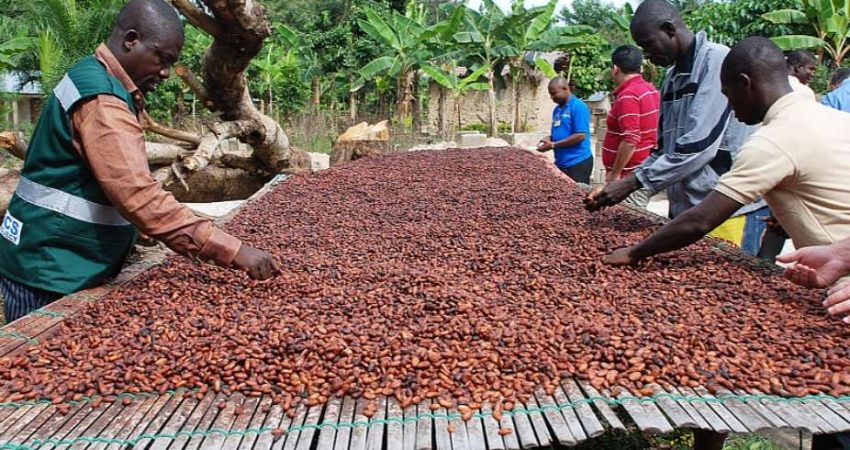
Ghana’s nearly one million cocoa farmers sustain a vital industry. As the world’s second-largest producer after Côte d’Ivoire, Ghana’s cocoa sector supports over a million farm households and millions of jobs across farming, transport, processing, and export logistics.
Yet the sector is under strain. In early 2026, after a sharp downturn in global cocoa prices, the Government of Ghana reduced the farm-gate price paid to farmers by approximately 29%. This decision triggered protests, demands for prompt payments, transparency in price-setting, and a more equitable share of global cocoa revenues. Much of the debate on cocoa pricing, however, misses the core issue: can the government compel farmers to sell their cocoa to the Ghana Cocoa Board (COCOBOD) at below-market prices set by COCOBOD?
The Ghana Cocoa Board Act, 1984 (PNDCL 81) (“the Act”) requires cocoa farmers to sell their produce only to COCOBOD or its authorized agents, Licensed Buying Companies (LBCs). COCOBOD and the government set the price. Under the Act, selling cocoa to any buyer other than COCOBOD or its agents is punishable by 5 – 8 years’ imprisonment.
Historical antecedents of COCOBOD
Cocoa marketing in the Gold Coast was handled by private firms until World War II, when the colonial government took control, selling cocoa to the British Food Ministry. In 1947, the Cocoa Marketing Board was established with a monopsony over internal and external marketing and later added extension services. Following political transitions and reforms, the institution evolved into COCOBOD after 1979. Initially, its mandate included stabilizing producer prices and protecting farmers from global market volatility. Over time, however, it functioned as an implicit taxation scheme, keeping producer prices significantly below world prices. What began as a temporary wartime measure has thus persisted as a structural feature of Ghana’s cocoa industry across successive administrations.
Does the Act Comply with the Constitution?
Article 18 of Ghana’s Constitution guarantees property rights. Property includes immovable property and movable property, including agricultural produce such as cocoa. Property rights include core incidents, namely, the right to possess, use, and sell. An owner’s right to decide the price at which to sell their property has long been recognized as a basic part of owning property. Cocoa farmers should, therefore, have the right to negotiate and set prices for their produce, sell to buyers of their choice, and freely access markets.
Admittedly, property rights, like all rights, are not absolute. But the state’s power to limit those rights is not absolute either. When the state restricts a constitutional right, it must show a clear and compelling public interest for justification.
Under Article 20 of the constitution, compulsory acquisition of property is only permissible where it is necessary for a listed public purpose, such as public safety and order or development for public benefit. The necessity must be clearly stated, reasonably justified, and take into account the hardship caused, including fair compensation paid.
Forcing farmers to sell to a single buyer (COCOBOD or LBCs) on the pain of criminal sanctions, at a below-market price unilaterally set by COCOBOD, violates Article 20. Although the government does not physically seize cocoa without payment, the practical effect of the Act is that farmers’ hard-earned produce is taken by the government/COCOBOD through legal compulsion.
Equally effective, less restrictive means exist
While the Act has public interest justifications, such as shielding farmers from price volatility, ensuring quality control and revenue mobilization, it has, therefore, created a monopsony, displacing property rights, even though there are less restrictive and equally effective means of achieving those objectives.
The state has a revenue interest because cocoa exports generate significant foreign exchange for the government. Revenue alone, however, cannot extinguish property rights. If it could, any profitable sector could be monopolized and any private commodity compulsorily routed through the State. The Constitution does not allow rights to be overridden merely for revenue generation. A less restrictive approach would be for COCOBOD, as regulator, to impose income and export taxes, license fees, or fines on non-compliant market participants while leaving farmers’ property rights intact.
Some also argue that centralizing cocoa purchasing ensures grading standards, prevents smuggling, and protects Ghana’s premium reputation. Quality control, however, does not require a single buyer. Licensing requirements, grading systems, export certifications, regulatory inspections, and civil penalties can achieve the same goal. Around the world, many agricultural export sectors maintain high quality without a monopsony.
The State has long justified COCOBOD’s monopsony as a shield against price volatility. But if COCOBOD cannot secure better prices, remains heavily indebted, and most gains flow to international buyers, the public interest case is weak. Under the current framework, high prices benefit the government and LBCs, while farmers bear most losses when prices fall.
Comparative Models
Several major cocoa-producing countries operate successful cocoa sectors without a state monopsony, instead relying on regulated but competitive market structures. Indonesia, the world’s third-largest cocoa producer, for example, stabilizes prices through competitive markets, farmer organizations, and targeted support without a state monopoly. Ghana is the only country that has not abolished its marketing board and maintains a state monopsony on cocoa beans.
The minerals contrast
Some might argue that the same analysis should apply equally to minerals like gold. However, cocoa and minerals are treated very differently under Ghanaian law. Cocoa is the private property of the farmer, who has the right to negotiate prices and sell to buyers of their choice. The government cannot compel farmers to sell exclusively to COCOBOD without infringing these rights, except under narrow constitutional exceptions under Article 20. Minerals, by contrast, are owned by the State in its natural form under Article 257(6), empowering the government to require anyone who finds minerals to surrender or sell to the State.
Conclusion
Growing cocoa is hard work because cocoa trees are high maintenance. It takes 3–5 years before farmers can harvest their first pods. Farmers rise before sunrise to clear land, spray, and prune trees, then harvest, sun-dry, and bag the seeds. Yet many farmers, living in rural villages with limited infrastructure, are deprived of the revenue they deserve. It is time for the Government of Ghana to address this injustice. A reformed industry should see farmers actualize their full property rights while COCOBOD maintains its regulatory role by licensing buyers, enforcing quality standards, and providing training and extension services.

Nicholas Opoku is a lawyer with 5 years of experience spanning legal policy, corporate law, and strategic litigation.
**Featured image: https://www.modernghana.com/