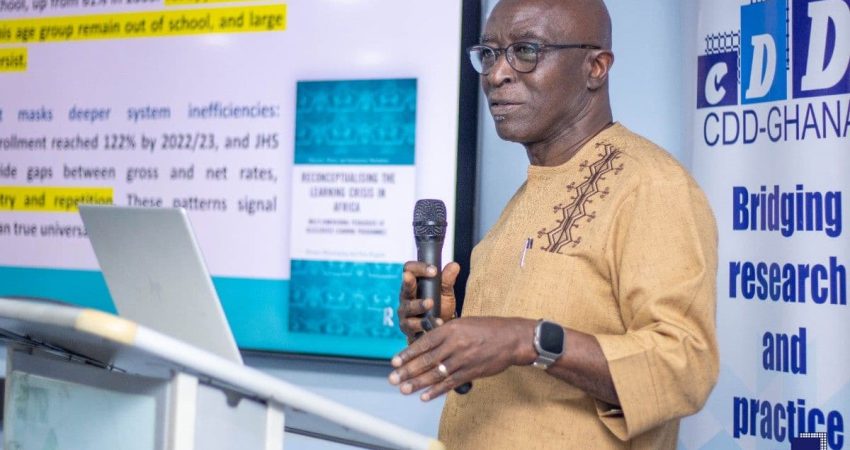
A Senior Fellow at the Ghana Center for Democratic Development (CDD-Ghana), Professor Kwame Akyeampong, has bemoaned the failure of the country’s education system to deliver inclusive, equal opportunities and equitable and fair distribution of public resources and services.
The Senior Fellow argued that such failure has resulted in unequal and inequitable learning outcomes.
Delivering a lecture on the theme “Reconceptualising the ‘Learning Crisis’ for Social Justice: The Case of Ghana,” Prof. Akyeampong stressed that education remains central to national development and is a crucial tool for achieving social justice.
He noted that “a lot of development will be stunted if we don’t use education as a vehicle for social justice.”
Reflecting on recent policy directions, he observed that during the Nana Akufo-Addo administration, emphasis was placed on access, citing the government’s flagship Free Senior High School (FSHS). Though commendable, he argued that limited attention was given to foundational levels such as pre-primary and primary education, where core learning gaps persist. According to him, while access to schooling has improved, learning outcomes remain weak.
Citing data from the 2024 National Standardised Test, Prof. Akyeampong indicated that 44% of Primary 4 pupils fall below basic proficiency in English, while 38% fall below proficiency in Mathematics. He added that many pupils fail to attain basic literacy and numeracy by the end of primary school.
He further explained that although enrolment has expanded, a significant number of children do not progress through the full education cycle. Using enrolment trends, he described a steady decline from pre-primary through to senior high school. “Ghana shouldn’t be facing this learning crisis,” he said, noting persistent regional disparities and the prevalence of out-of-school children.
Addressing policy direction, Prof. Akyeampong distinguished between equality and equity in education. He argued that equality, providing the same resources to all, is insufficient in addressing structural disadvantages. Instead, he emphasised equity as a deliberate redistribution of resources to support disadvantaged groups, including children in rural areas, those with disabilities, and those from low-income backgrounds.
“Equity is a political choice,” he noted, adding that policy must decide whether the goal is universal access or ensuring that no child receives a poor-quality education relative to others. He stressed that political incentives often shape educational policy.
On teacher deployment and infrastructure, he cautioned against neglecting rural education, stating that policies that fail to prioritise underserved areas are “anti-development.” He also called for increased investment in less-endowed schools, particularly at the senior high level.
Prof. Akyeampong highlighted language barriers as a key contributor to poor learning outcomes. “Language is a bridge to belonging,” he said, pointing out that many children are taught in languages they do not understand. He advocated for complementary basic education models that incorporate local languages, community knowledge, and interactive teaching methods.
He also underscored the role of community involvement, particularly mothers, in improving learning outcomes. He noted that about 150,000 women have been trained in community-based educational support initiatives, contributing to improved learning in some areas.
During a discussion session, Professor H. Kwasi Prempeh raised concerns about the increasing shift from public to private schooling. In response, Prof. Akyeampong attributed this trend to perceived poor outcomes in public schools.
He further linked educational challenges to broader societal issues, stating, “The learning crisis is a moral crisis and a social injustice.” He warned that development cannot be meaningful if large segments of the population are left behind, adding that “It is who we have left behind that is the marker of our development.”
The lecture also addressed concerns about a “one-size-fits-all” curriculum, the erosion of values in education, and the risks of politicisation, including the involvement of politicians in private educational ventures.
Prof. Akyeampong concluded with a call for reforms that prioritise equity, improve quality inputs, and reduce disparities across the education system, warning that failure to act would deepen inequalities in Ghana’s development trajectory.
Watch the livestream of the lecture below.
[embedyt] https://www.youtube.com/watch?v=s7ljj4nd3dc[/embedyt]